A Different Idea for Smart Glasses
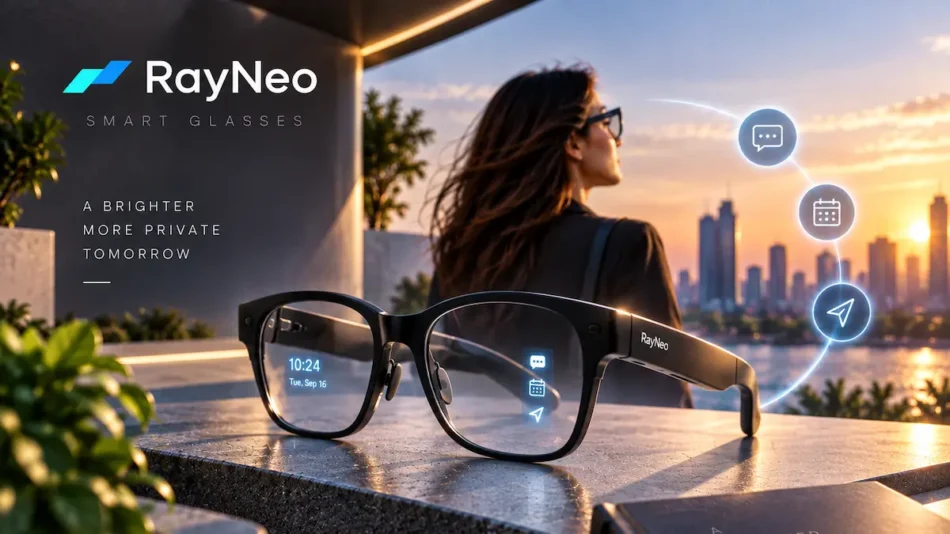
Smart glasses usually come with cameras, microphones, speakers, and smart features. They can take photos, record videos, answer questions, and connect with an AI assistant. RayNeo is trying something different with its iO smart glasses by removing the camera completely.
The idea may sound unusual, but it solves an important problem. A camera on someone’s glasses can make people around them wonder if they are being recorded. RayNeo’s camera-free approach focuses more on displays, audio, AI assistance, and privacy.
The iO is designed to provide information directly in front of the user without requiring them to constantly check their smartphone.
Why Remove the Camera?
The biggest reason is privacy.
When someone takes out a smartphone, other people can usually see that they are taking a photo or recording. A camera built into glasses is much less obvious. This has created concerns about recording people without their knowledge.
RayNeo’s solution is straightforward. The iO does not have a camera, so it cannot secretly take photos or record videos. The company describes this approach as “Privacy by Design.”
Of course, camera-free does not mean completely private. The glasses still use microphones and connected services. Users should still understand how voice and other data are handled.
What Can the RayNeo iO Do?
Removing the camera does not mean removing useful features.
RayNeo iO includes a transparent display that can show information while the user continues looking ahead. The company describes it as an invisible 33-inch display. It can be used for notifications, schedules, information, and other tasks.
The glasses also offer AI-related features, live captions, translation, meeting notes, and a teleprompter. RayNeo says its translation system supports 55 languages and 109 accents.
This makes the iO different from smart glasses that mainly focus on taking pictures and videos.
Privacy Could Be a Major Advantage
A camera-free design could make smart glasses more comfortable in places where recording is sensitive.
Think about an office meeting, classroom, restaurant, or public event. People may feel uncomfortable around someone wearing glasses with a visible camera. Removing the camera eliminates that specific concern.
It could also make these glasses easier to use in workplaces. Some companies may not want employees wearing devices that can record video. A camera-free model removes one of the biggest reasons for such restrictions.
For users, the benefit is simple. They can use a wearable display and smart assistant without carrying a camera on their face.
What Do You Lose Without a Camera?
There is also a clear trade-off.
A camera can do things that a camera-free device cannot. It can capture photos, record videos, recognize objects, read visual information, and help an AI system understand what the wearer is looking at.
RayNeo offers camera-equipped glasses such as the X3 Pro, which provides a different set of features.
This means the choice depends on what the user wants. Someone who wants hands-free photography may prefer camera-equipped glasses. Someone who wants information, translation, audio, and privacy may prefer the iO.
RayNeo Is Not Abandoning Cameras
The company is not saying cameras have no place in smart glasses.
Instead, RayNeo appears to be creating different products for different users. Its camera-equipped glasses focus more on capturing and understanding the world, while the iO focuses on information and interaction.
That approach could become more common as the smart-glasses market grows. Instead of one product trying to do everything, companies could offer different models based on privacy, photography, displays, or AI features.
Could Camera-Free Glasses Become a Bigger Trend?
The idea may become more important as smart glasses become more common.
Reuters reported in September 2026 that Meta was also planning a camera-free version of its smart glasses, suggesting that manufacturers are looking at privacy-focused designs.
That does not guarantee camera-free glasses will become mainstream. However, it shows that the industry is considering alternatives to the camera-first approach.
A New Direction for Wearables
RayNeo’s camera-free smart glasses offer an interesting alternative to traditional smart glasses. Instead of focusing on recording the world, they focus on showing information and helping the user interact with technology.
The biggest question is what people actually want from smart glasses. Some users may want a wearable camera. Others may prefer a private display that provides useful information without recording people around them.
RayNeo’s approach shows that the future of smart glasses does not have to look like a smartphone placed on your face. It could be something much simpler, more private, and focused on everyday information.