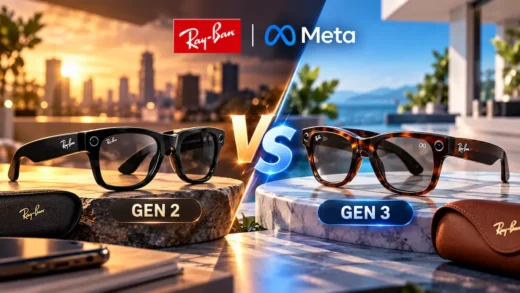
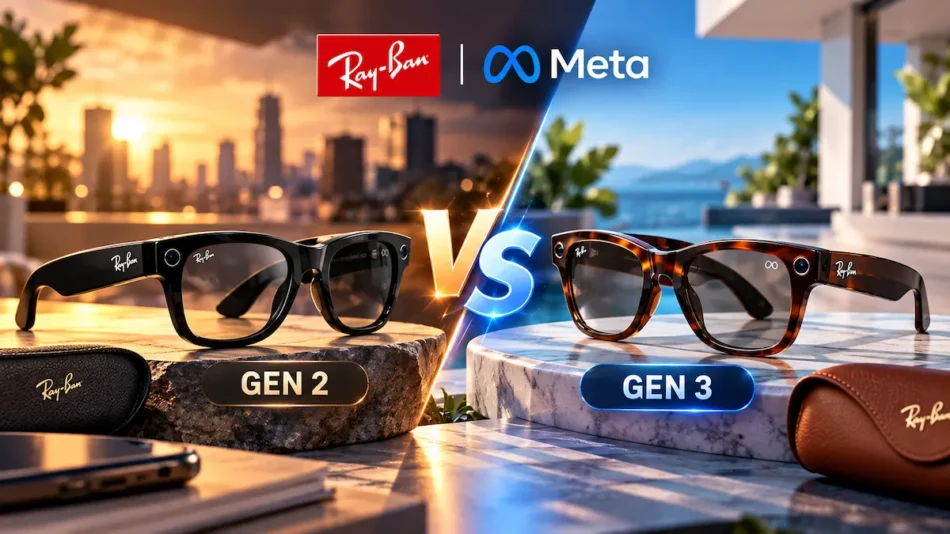
Ray-Ban Meta smart glasses have quickly become one of the most interesting wearable products on the market. Now, Meta has introduced the Ray-Ban Meta Gen 3 with a slimmer design, longer battery life, improved microphones, new controls and more frame choices.
At first glance, the new glasses may look like a major upgrade. However, the differences become more interesting when you compare the Ray-Ban Meta Gen 3 vs Gen 2 closely. The camera resolution remains the same, while several improvements focus on comfort and everyday use.
So, what exactly has changed between the two generations?
Ray-Ban Meta Gen 3 vs Gen 2: Design
Design serves as the most noticeable difference. Meta highlights that the Gen 3 features a sleeker profile intended for enhanced daily comfort, along with customizable temple tips to help wearers personalize their fit.
According to Ray-Ban, the camera and LED opening on the Gen 3 models are 36% smaller, resulting in a more discreet design.
Gen 2 was already designed to look like regular Ray-Ban eyewear, but Gen 3 expands the styling options. The new generation comes in Wayfarer, Aviator and Zena designs, with 27 lens and color combinations.
The Aviator is particularly notable because Ray-Ban is celebrating the design’s 90th anniversary. There is also a limited-edition Aviator version for buyers looking for something different.
Battery Life Gets a Small but Useful Boost
Battery life is one of the most practical improvements in Ray-Ban Meta Gen 3.
According to Meta, the Gen 2 model provides up to eight hours of usage per charge, whereas the Gen 3 extends battery endurance to up to nine hours. Additionally, both generations include a charging case for extra battery capacity, with the Gen 3 case offering up to 50 additional hours of power.
While an additional hour of battery performance might seem minor, smart glasses are meant for all-day wear, making any gain in uptime valuable.
Actual battery performance will vary based on feature usage, as activities like video capture, phone calls, audio streaming, and Meta AI interactions consume more power.
The Camera Has Not Received a Major Resolution Upgrade
This is where the Gen 3 upgrade becomes less dramatic.
Both generations feature a 12MP camera and support 3K Ultra HD video recording. That means Gen 2 owners should not expect a huge jump in image resolution simply by moving to Gen 3.
Gen 3 improves the camera experience with dynamic photos to select better frames and a smaller, less noticeable opening. However, camera-focused upgraders may find the hardware changes insufficient.
Gen 3 Adds a Sixth Microphone
Audio and voice interaction receive a more meaningful upgrade.
Ray-Ban Meta Gen 2 uses a five-microphone system. Gen 3 moves to a six-microphone array with improved wind noise reduction. Meta says the new system can reduce background noise by more than 90%.
This matters because voice commands are a major part of the Meta glasses experience.
You can use your voice to interact with Meta AI, make calls, send voice messages and control different functions. Better microphone performance should be especially useful outdoors, where traffic, wind and other people can make voice input difficult.
Independent testing will ultimately tell us how noticeable this improvement is in everyday situations. Still, adding another microphone is a practical hardware change rather than simply a cosmetic update.
A New Customizable Action Button
One of the clearest Gen 3 changes is the new assignable action button.
On Gen 2, users rely mainly on voice commands, the capture button and touch controls. Gen 3 adds another physical control that can be assigned to a preferred function.
For example, users can set it to quickly access Meta AI or another supported feature. This gives users a faster way to perform common actions without saying a voice command every time.
This may seem like a small addition, but it could become one of the most useful changes for regular users.
AI Features Are Still a Major Part of Both Generations
The Ray-Ban Meta Gen 3 is still built around Meta AI.
Users can ask questions, interact with AI about what they are seeing, translate text, listen to music, make calls and perform other hands-free tasks. Meta is also expanding its AI glasses ecosystem with new AI experiences and its Muse personal AI agent.
However, buyers should not expect Gen 3 to completely replace Gen 2 in terms of core AI capabilities.
Many of the main functions remain available across the two generations. The bigger difference is that Gen 3 provides newer hardware for interacting with those features.
That makes the upgrade more about refinement than a complete change in what the glasses are designed to do.
Price: Gen 3 Costs More
Price is another important difference.
The Ray-Ban Meta Gen 2 originally launched in the US from around $379, while Gen 3 starts at $449. That represents a $70 increase over the previous starting price.
The higher price makes the upgrade question more complicated for existing Gen 2 owners.
New buyers, however, are getting longer battery life, a new microphone system, an action button, updated styling and newer hardware.
Ray-Ban Meta Gen 3 vs Gen 2: Should You Upgrade?
The answer depends largely on which generation you currently own.
If you already have Gen 2, the upgrade is not a complete hardware revolution. The camera remains 12MP, 3K video recording remains available, and the basic AI experience is familiar.
Gen 3 makes more sense if you care about longer battery life, better voice pickup, the new action button, slimmer styling or the new frame designs.
For people buying their first pair of Meta smart glasses, Gen 3 offers the newest version of the platform and avoids buying older hardware at a similar price.
Final Thoughts
The Ray-Ban Meta Gen 3 vs Gen 2 comparison shows a product that has evolved rather than been completely redesigned.
Gen 3 focuses on the details that affect everyday use. It offers up to nine hours of battery life, six microphones, improved wind noise reduction, adjustable temple tips and a customizable action button. The camera, storage and many core AI features remain broadly familiar.
That makes Gen 3 an interesting upgrade, but not necessarily an essential one for every Gen 2 owner.
The bigger story is what Meta is building around these glasses. With AI becoming a bigger part of everyday wearable technology, Ray-Ban Meta Gen 3 shows that Meta is continuing to improve the glasses without making them look like a traditional high-tech gadget.