
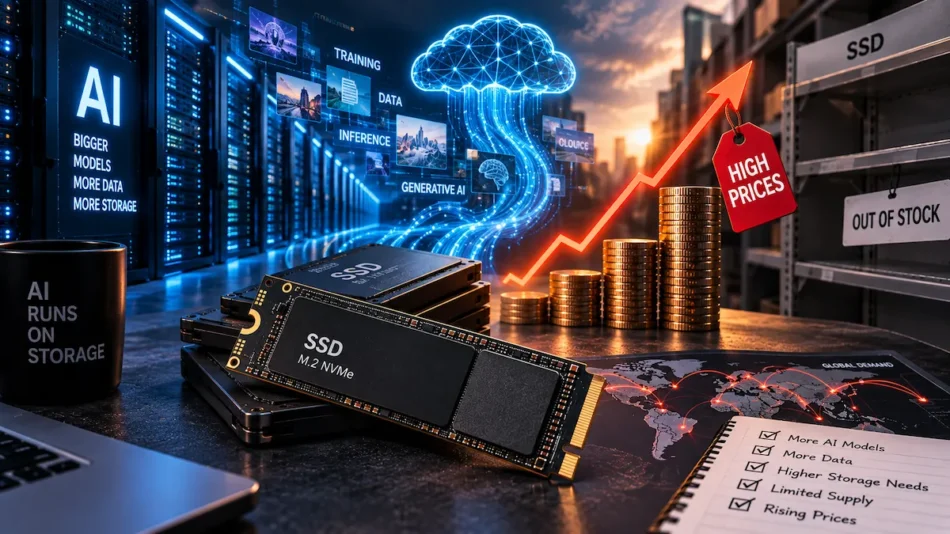
SSD prices are rising as the AI boom creates new demand for storage. For years, SSDs became faster, larger, and more affordable. Now, the growing number of AI data centers is changing that trend.
AI systems need huge amounts of data and storage. Data centers are buying enterprise SSDs in large volumes, putting additional pressure on the NAND flash market. That pressure can eventually reach ordinary PC buyers through higher storage costs.
Why Are SSD Prices Rising?
SSDs rely on NAND flash memory. When NAND becomes more expensive or harder to secure, SSD manufacturers face higher costs.
What’s interesting right now is the sharp contrast between business and consumer appetite. Market research from TrendForce in September 2026 highlights that while individual PC buyers are spending cautiously, cloud providers and AI infrastructure builders are buying aggressively. In particular, growing demand for QLC-based enterprise storage is pulling enterprise SSD prices upward, even as the standard consumer spot market stays relatively calm.
Crucially, a price surge doesn’t require a total shortage of every drive on the shelf. Even if scarcity is limited to high-capacity enterprise drives, it shifts the overall supply chain dynamics for everyone sharing the same NAND resources.
How AI Is Reshaping Storage Needs
The scale of AI data consumption is fundamentally different from everyday computing. Where a home desktop or gaming laptop gets by on a few hundred gigabytes or a couple of terabytes, large-scale AI models process petabytes, requiring massive pools of fast storage across data center racks.
AI models also generate information. Search queries, documents, images, videos, logs, model checkpoints, and other data all need to be stored somewhere. As AI services become more widely used, data centers need more storage to support them.
AI systems need far more storage than a normal computer. A regular PC may work with a few hundred gigabytes or a few terabytes of storage. Large AI systems handle huge amounts of data, so they need much more high-capacity storage across data centers.
Why Enterprise SSD Demand Matters
Enterprise SSDs are not the same products most people buy for a gaming PC. They are designed for data centers and heavy workloads, with different requirements for endurance, reliability, capacity, and performance.
The important point is that manufacturers have limited production capacity. If more capacity is allocated to enterprise products with strong demand, consumer storage can face tighter availability or higher costs.
TrendForce’s September 2026 research shows that demand for enterprise SSDs is strong, while demand from regular consumers is much weaker. So, it is not correct to say that all SSDs are becoming harder to find. The market is more complicated because different types of SSDs are seeing different levels of demand.
What Does This Mean for PC Buyers?
For regular users, rising SSD prices could affect the cost of buying a new SSD, laptop, or desktop PC. If storage becomes more expensive, manufacturers may choose to include less storage in some devices to keep prices under control.
According to TrendForce, higher component costs are already putting pressure on PC makers. The company also reported that some PCs were being offered with lower storage capacities.
This shift hits gamers especially hard, given that modern titles routinely swallow 100 GB or more of space. Higher-capacity laptops will likely command a steeper premium, while budget models might require extra trade-offs.
Will SSD Prices Keep Rising?
It is hard to say how long SSD prices will stay high. Right now, strong demand from AI data centers is putting pressure on the NAND market.
There is also a new development from China. CXMT is preparing to enter the NAND flash market, which could increase supply and competition in the future. However, new production takes time, so it may not reduce prices immediately.
For now, AI demand remains strong, while manufacturers are working to increase supply. SSD prices will depend on how quickly that new supply reaches the market.
The Bigger Global Impact
The future of SSD prices will depend on how quickly NAND manufacturers can increase supply and how strongly AI infrastructure continues to grow.
That creates a chain reaction. Data centers buy more enterprise SSDs. Manufacturers adjust production. Component costs change. PC makers face higher storage costs. Consumers may then pay more or receive less storage at the same price.
This does not mean every SSD is suddenly unaffordable. Prices vary by brand, capacity, interface, and market. But the direction of the industry is worth watching.
The AI boom is creating a hidden cost that many users may not notice until they upgrade their next PC or laptop. Storage has always been a basic part of computing. Now, as AI systems consume more data than ever, SSDs are becoming an important part of the global AI infrastructure story.