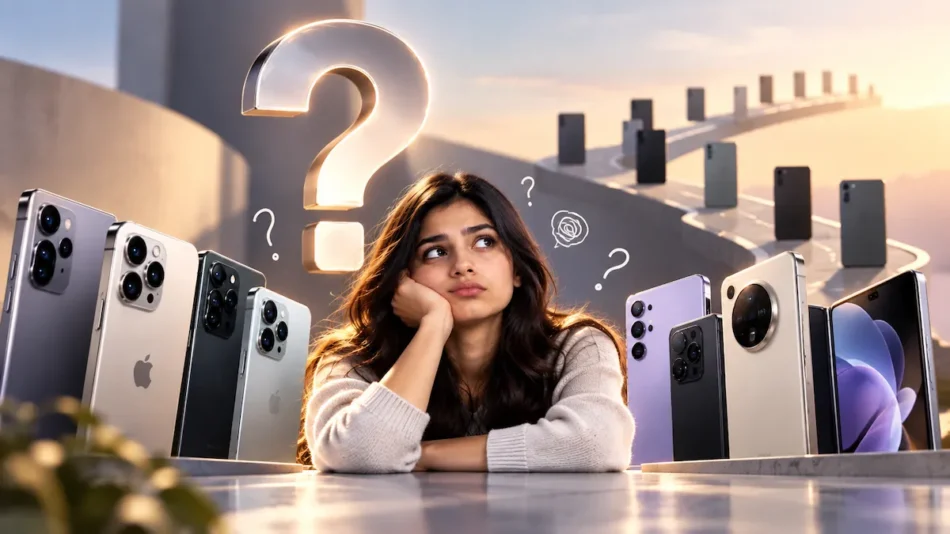
Smartphones are boring in 2026, at least compared with the excitement they created a few years ago. A new phone could bring a completely different design, a much better camera, a faster processor, or a feature that changed how people used their devices.
In 2026, that excitement feels harder to find.
Today’s phones are faster, more reliable, and more capable than ever. Yet many new models look and feel almost identical to older ones. Bigger cameras, faster chips, brighter screens, and new AI tools are everywhere, but they rarely create the same thrill as phone updates used to.
So, why are smartphones so boring in 2026?
Why Smartphones Are Boring in 2026: Design Has Stopped Changing
The biggest reason is simple: most smartphones look almost the same.
Almost every smartphone still uses the same basic style: a large glass screen, a thin body, flat or slightly curved sides, and cameras on the back. Companies try new colors, frame materials, or camera shapes, but the core design has barely shifted.
This isn’t because companies have stopped trying. Phone design has simply reached a point where big changes cause new problems.
Thinner phones can mean smaller batteries. Larger camera sensors require more space. Foldable phones solve the screen-size problem but introduce higher prices and mechanical complexity.
As a result, manufacturers often choose refinement instead of a complete redesign.
Why New Smartphones Feel Like Minor Upgrades
Another problem is the yearly upgrade cycle.
Companies release new models every year, making people expect big improvements each time. But phone tech doesn’t move fast enough to match that pace.
A new chip might be faster, but most people won’t notice any difference while using WhatsApp, Instagram, YouTube, Chrome, or Spotify.
Cameras have improved dramatically over the years, but improvements between two consecutive generations are often much smaller. The same is true for displays and battery life.
A 2026 flagship can be technically impressive while still feeling almost identical to a three-year-old flagship in everyday use.
One recent Android Authority survey found that more than 44% of respondents said they keep their phones for three to five years, while more than 28% said they keep them for over five years.
That tells us something important. Consumers are not necessarily demanding a completely new phone every year.
AI Was Supposed to Make Phones Exciting Again
Artificial intelligence has become one of the biggest selling points of smartphones in 2026.
Almost every major manufacturer now talks about AI. Phones can summarize information, edit photographs, translate conversations, generate text, recognize objects, and provide more personalized assistance.
However, there is a catch.
For many users, AI features still feel like additions rather than a completely new way of using a smartphone.
A survey of 2,407 U.S. smartphone owners conducted by YouGov for CNET found that only 12% cited AI integrations as a reason they would consider upgrading. Foldable designs were cited by 13%. Price, battery life, and storage were much stronger upgrade factors.
This does not mean smartphone AI is useless. It means the technology has not yet created a strong enough reason for most people to replace a perfectly working phone.
Better Cameras Are Not Enough Anymore
Camera upgrades used to be the easiest way to convince people to buy a new phone.
Today, even mid-range phones can take excellent photos in good lighting. Premium smartphones have reached an even higher level, with large sensors, optical zoom, computational photography, and advanced video features.
The problem is that the improvements are becoming harder to notice.
A phone launched in 2026 may produce better photos than a phone from 2023. But for social media, messaging, and everyday photography, the older phone can still be good enough.
That creates a strange situation. Smartphone cameras keep improving, but the emotional impact of those improvements keeps getting smaller.
Performance Has Become Too Good
The same thing is true for processors.
Every generation brings faster CPUs, stronger GPUs, and more powerful AI processing. Smartphone companies proudly highlight performance gains during launches.
But most users are not pushing their phones hard enough to experience those gains.
Opening social media apps does not require the latest flagship chip. Watching Netflix does not require it either. Even everyday gaming can work well on older premium hardware.
This creates a limit on how much speed actually matters.
Once a phone is already fast enough, making it 20% or 30% faster does not necessarily make the experience 20% or 30% better.
Folding Phones Are Cool, But Still Rare
Foldable phones remain one of the most exciting developments in the smartphone industry.
They can turn a normal-sized phone into a larger screen device. They also give manufacturers a way to change the traditional smartphone design.
But foldables have not completely transformed the market.
In India, foldables still account for less than 1% of the smartphone market, while their global share is around 2%, according to recent reporting.
High prices remain the main reason.
For most consumers, paying significantly more for a foldable does not make enough sense when a conventional flagship already provides excellent performance, cameras, and battery life.
Foldables may eventually become more common, but they have not yet replaced the traditional smartphone.
Longer Software Support Is Changing Consumer Behaviour
There is also a positive reason smartphones feel boring: they are lasting longer.
Manufacturers now provide much longer software and security support. Samsung and Google, for example, have made six or seven years of updates increasingly common on newer devices.
This is great for consumers, but it reduces the pressure to upgrade.
If your three-year-old phone still receives updates, runs modern apps, takes good photos, and has decent battery life, why replace it?
Deloitte also points to longer upgrade cycles and market saturation as major factors affecting smartphone demand.
Phones Are Also Becoming More Expensive
Price is another important part of the story.
The smartphone market is facing higher component costs, particularly around memory. AI data centers are consuming huge amounts of advanced memory, putting pressure on supplies used across consumer electronics.
TechCrunch notes that higher memory costs in places like India are lifting phone prices, leading people to keep their devices for around four years.
At the same time, research firm Omdia expects global phone shipments to drop significantly in 2026, even as high-end phones make up a larger slice of sales. Their reports also highlight longer ownership times and a growing market for used phones.
That creates a difficult situation for manufacturers. They need to sell new phones, but consumers have fewer reasons to replace their existing ones.
Why Smartphones Are Boring Despite Being Better
Perhaps the biggest insight is that smartphones are not actually getting worse.
They are becoming too mature.
The basic smartphone experience has already solved many of the problems users had ten years ago. Displays are excellent. Cameras are powerful. Processors are fast. Batteries are better. Software is more polished. Connectivity is faster.
The industry is now trying to improve products that are already very good. That makes every small update feel less impressive.
This is why a 2026 smartphone can be technologically impressive and still feel boring.
What Could Make Phones Exciting Again?
The next major breakthrough probably cannot simply be another faster processor or another camera sensor.
Smartphones need a change in how people interact with them.
AI could eventually become more useful if it can reliably perform tasks instead of simply generating text or images. New battery technology could make phones last several days. Better foldables could offer completely new form factors without huge price increases.
We could also see phones become less dependent on traditional apps and menus, with AI handling more tasks in the background.
That would be a much bigger change than adding another camera mode.
The Boring Smartphone Era May Actually Be a Good Thing
The smartphone industry may feel less exciting in 2026 because it has reached maturity. That sounds negative, but there is another way to look at it.
Consumers no longer need to buy a new model as soon as it arrives.
A three-year-old flagship phone is still fast, safe, and powerful. Longer software updates give people the freedom to keep their devices longer. And when they finally decide to upgrade, they can demand real improvements rather than tiny spec bumps.
So yes, smartphones are boring in 2026.
But perhaps the real story is that smartphones have become so good that small improvements are no longer enough to impress us.
The next exciting smartphone will not be the one with slightly better specifications. It will be the one that changes what we expect a smartphone to do.