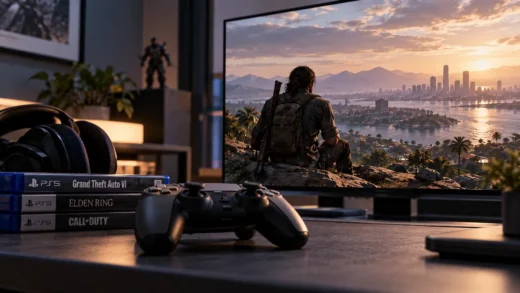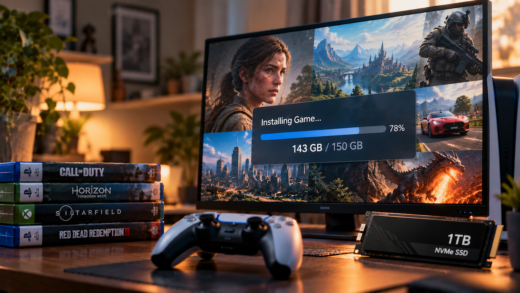
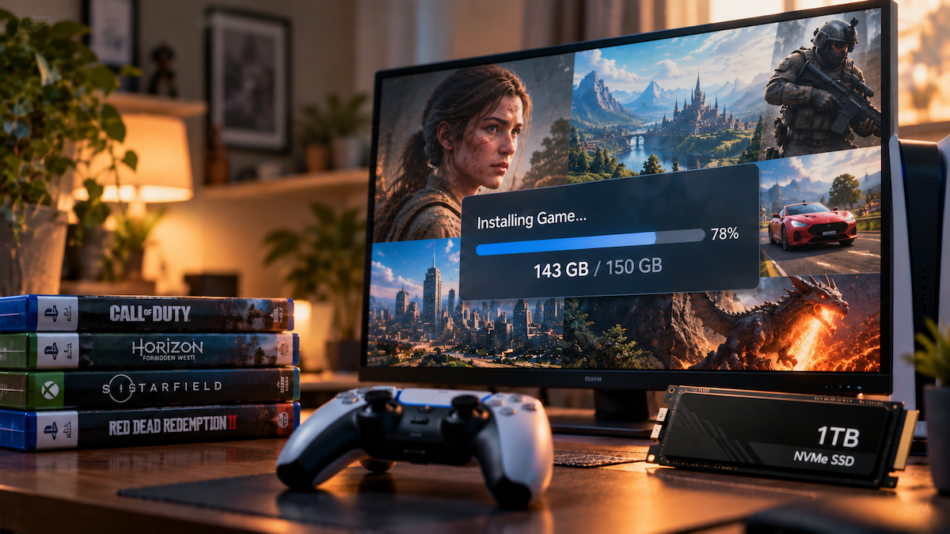
Modern games are getting bigger every year. A game that once needed 20GB or 30GB can now require 100GB or even more. Some large AAA titles can cross 150GB after updates and extra content. This can quickly become a problem for players with limited SSD space.
But why modern games need so much storage is not because of one single feature. Better graphics, huge open worlds, high-quality audio, detailed characters, cinematic content and regular updates all contribute to the growing file sizes.
Better Graphics Mean Larger Game Files
One of the biggest reasons modern games take up so much space is graphics. Games today use highly detailed textures, realistic lighting, advanced shadows and complex 3D models.
A simple object in an older game could use a relatively small texture. Modern games often use much higher-resolution textures to make surfaces look realistic. A wall may have visible cracks, dirt and small details. A car can have separate textures for its paint, windows, tires and interior.
All these files add up.
High-resolution textures are especially important in games designed for modern consoles and gaming PCs. Developers want objects to look sharp even when players get close to them. This requires much more data than older games needed.
Open-World Games Need Thousands of Assets
Large open-world games are another major reason game sizes continue to increase.
A modern open-world game can contain cities, roads, buildings, vehicles, characters, animals, trees, shops and countless smaller objects. Each of these elements needs data.
Consider a large city in a game. Developers have to create buildings, roads, traffic, pedestrians, signs, interiors, sounds and environmental details. They may also create different versions of these assets for different situations.
The map itself may not be the biggest part of the installation. It is everything placed inside that world that adds up.
This is why games with massive maps can require so much storage.
Modern Characters Are More Detailed
Characters have also become much more complex.
A modern game character can contain detailed skin textures, hair, clothing, facial expressions and different animations. Developers may create separate models depending on how close the player is to the character.
A character needs animations for walking, running, jumping, fighting, driving and interacting with objects. Story-focused games may have thousands of individual animations.
Character customization can increase the size even further. If players can change hairstyles, clothes, faces and accessories, the game needs many additional assets.
This is one small part of the larger answer to why modern games need so much storage.
4K Textures Take Up More Space
4K gaming is another important factor.
Higher-resolution textures contain more visual information. They can make surfaces look sharper and more detailed, but they also require more storage.
Some games provide optional high-resolution texture packs for players with powerful PCs or modern consoles. These packs can add several gigabytes to the installation.
The advantage is better image quality. The disadvantage is that players need more free storage.
Not everyone needs these high-resolution assets, which is why optional texture packs can be a useful solution.
Audio Can Take Up More Space Than Expected
Graphics usually get the attention when people discuss game size, but audio also matters.
Modern games can contain hours of dialogue, background music, environmental sounds and sound effects. A story-heavy game may have thousands of recorded lines.
Things become even larger when a game includes several languages.
A game might offer English, French, German, Spanish, Japanese and other voice tracks. Players may only use one language, but the installation can still include several language files.
High-quality audio also needs more storage than the basic sound effects used in older games.
Cinematic Content Adds More Data
Modern games increasingly use cinematic storytelling.
Games can include long cutscenes with detailed characters, voice acting and high-quality audio. Some scenes are rendered directly by the game engine, while others can use pre-rendered video.
Video files can become very large, especially when they use high resolution and high-quality sound.
A game with several hours of cinematic content can therefore add a significant amount of data to the final installation.
This is another reason modern story-driven games can become much larger than older titles.
Multiple Versions Can Increase the Size
Many modern games launch across multiple platforms.
A game may be available on PlayStation, Xbox and PC. Each platform has different hardware and technical requirements.
Developers sometimes need different versions of certain assets or files to make the game work correctly on each platform.
The exact impact depends on how the game is designed and packaged. However, supporting multiple platforms can contribute to larger game packages.
PC games can also have additional files for different graphics settings and hardware configurations.
Updates Make Games Even Bigger
The size of a game at launch is not always the size you will have to store later.
Modern games receive regular updates. These can include new missions, characters, weapons, maps, vehicles, events and seasonal content.
Live-service games are especially affected.
A game might launch at 80GB and become much larger after several years of updates. Developers continue adding content because they want players to keep returning to the game.
Updates can also require temporary storage during installation. Your console or PC may need additional free space to download and reorganize files.
So, a game that technically needs 100GB may require even more free space during an update.
SSDs Have Changed Game Design
Modern consoles and gaming PCs increasingly use SSDs instead of traditional hard drives.
SSDs are much faster at reading data. This allows developers to load game assets quickly while players move through large environments.
This technology has helped developers create more detailed worlds with fewer obvious loading screens.
However, there is a trade-off.
Games can stream more detailed assets into memory, but those assets still need to be stored somewhere. Faster storage does not automatically mean smaller games.
Instead, it has helped developers make better use of larger amounts of data.
Why Not Compress Everything?
A common question is simple: why don’t developers compress game files more?
Compression is already widely used. Developers try to reduce file sizes while keeping good image and audio quality.
However, compression has limits.
Some files can be compressed heavily without causing noticeable problems. Other files need to remain at higher quality.
Developers also need to consider loading speed. A smaller file is not always better if the system needs more time to decompress it during gameplay.
The goal is therefore to find a balance between storage size, quality and performance.
Bigger Games Are Not Always Better
There is an important difference between a big game and a good game.
A 150GB game is not automatically better than a 30GB game.
Storage size simply tells us how much data a game contains. It does not measure the quality of its story, gameplay or overall experience.
Smaller games can provide excellent experiences without huge maps and ultra-detailed graphics.
At the same time, large AAA games need more storage because they are trying to offer bigger worlds, more content and higher visual quality.
The size often reflects the type of experience developers want to create.
Will Game Sizes Keep Increasing?
Game sizes are likely to remain large as technology improves.
Developers are constantly pushing for better graphics, more realistic characters, larger worlds and more detailed environments. These improvements require additional data.
However, better compression and smarter installation systems could help control the problem.
Developers could also give players more control over what they install. Optional language packs, texture packs and multiplayer content could allow players to save storage by downloading only what they actually need.
This could become increasingly useful as SSDs fill up faster.
The Real Reason Games Are So Large
The answer to why modern games need so much storage comes down to one simple fact: games now contain much more data than they did in the past.
A single AAA game can include thousands of textures, 3D models, animations, audio files, voice recordings, videos and environmental assets. Regular updates can add even more content after launch.
The storage requirement is therefore not caused by graphics alone. It is the combination of larger worlds, better visuals, detailed characters, high-quality audio, cinematic content and ongoing updates.
For gamers, this creates a new problem. A 1TB SSD may sound like plenty of storage, but a handful of large games can use a huge portion of it.
As games continue to become more ambitious, managing storage will become almost as important as managing graphics settings.
The future of gaming may bring even better compression and smarter installation options, but one thing is already clear: game sizes are unlikely to return to the small installations players were used to years ago.