Artificial intelligence is changing how people search for information, complete tasks, and interact with software. Two terms that often appear are AI agents and AI chatbots. They sound similar, but they serve different purposes.
An AI chatbot mainly focuses on conversation. An AI agent can take conversation a step further by planning actions and completing tasks. Understanding this difference helps businesses choose the right technology.
What Is an AI Chatbot?
An AI chatbot is a computer program made to talk with people through text or voice. It can answer questions, explain things, write text, and help users find information.New chatbots use advanced language technology to understand normal human speech and reply. For example, a customer might ask how to return an item, when a package will arrive, or how a product works. The chatbot can understand the question and give an answer in just a few seconds.
The goal is communication. A chatbot responds to what the user asks, but it may not independently decide what actions should happen next.
Chatbots are helpful for customer service, guiding website visitors, teaching, writing text, and helping employees. They can easily answer the same common questions over and over again for many daily tasks.
What Is an AI Agent?
An AI agent is built to do much more than just talk. It can understand a goal, plan the steps needed, use different tools, look at allowed information, and do the actual work to finish a task.
For example, imagine asking an agent to set up a business meeting. Instead of just telling you how to schedule it, the agent can check your approved calendar, find times when people are free, write the invitation, and send it out after you say yes.
This ability to take action is the main difference between AI agents and chatbots. An agent can complete a long, step-by-step process instead of stopping right after it gives you an answer.
AI Agents vs AI Chatbots
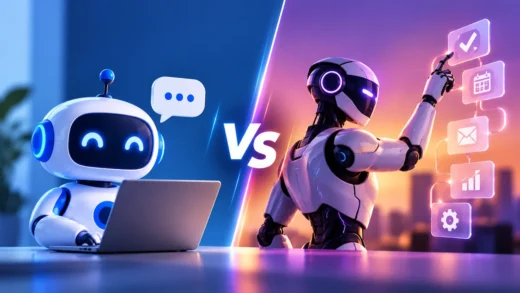
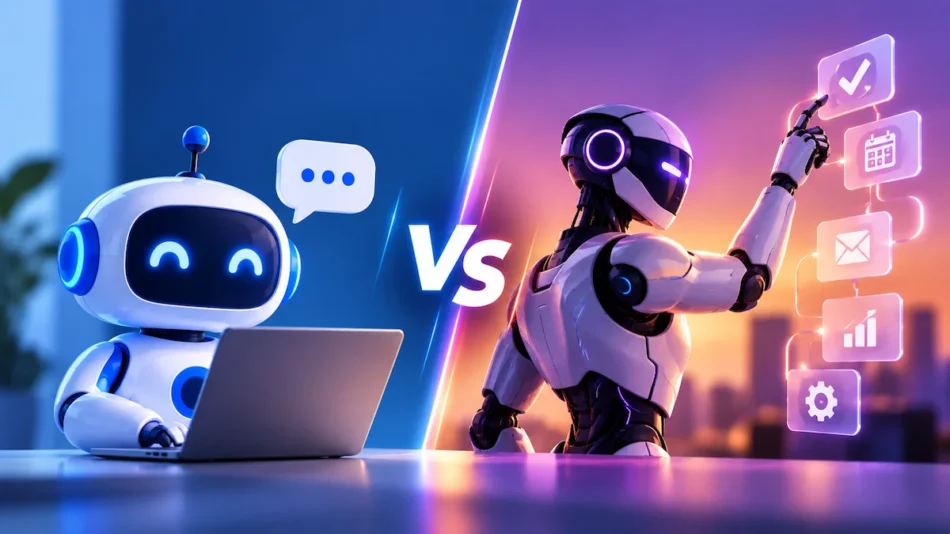
The difference is answers vs actions.
A chatbot might answer, “Your order is expected to arrive tomorrow.” An AI agent could check the order system, confirm the latest shipping status, identify a delay, and create an approved support request if needed.
This does not mean every chatbot is basic or every agent is fully autonomous. Modern AI systems can combine chatbot and agent features. The important difference is the system’s ability to plan and act toward a goal.
How AI Agents Work
AI agents typically combine several components. A language model helps understand instructions and make decisions. Tools allow the system to interact with calendars, databases, software, APIs, or other services.
The agent can also remember past details or saved information when needed. It can break a big goal into smaller tasks, finish them one by one, check its own work, and change the plan if something goes wrong.
Where Chatbots Work Best
Chatbots remain useful because many problems do not require complex automation. If a customer wants to know store hours, a product specification, or a policy, a chatbot can provide a quick answer.
They can also be easier to deploy and manage. A business may use a chatbot to reduce support workload while keeping human staff available for unusual or sensitive cases.
For simple information-based tasks, adding agent-level automation may create unnecessary complexity.
Where AI Agents Work Best
AI agents are most helpful when a task has many steps or needs to work with other computer systems. Good examples include answering customer help messages, finding information across safe sources, writing reports, organizing daily work, and doing repetitive business tasks
They can save time because users do not have to guide the system through every step.
However, more capability also means more responsibility. Businesses need clear permissions, security controls, monitoring, and human approval for actions that could create financial, legal, or operational consequences.
The Future of AI Assistants
The line between chatbots and agents will likely become less obvious as AI products improve. Many future assistants may combine natural conversation with the ability to complete tasks.
A user could ask a question in normal language and then expect the system to take the next appropriate step. For example, instead of asking how to compare invoices, a user might ask an AI system to compare them and highlight unusual charges.
The important question is what the system can do, which tools it can access, and how much control the user has.
Final Thoughts
AI chatbots and AI agents are similar, but they fix different problems. Chatbots are mostly made to talk and give answers. On the other hand, AI agents are built to understand a final goal, plan out the steps, use software tools, and do the actual work.
For regular users and companies, picking the right one depends on what you need to do. If you just want quick facts or a simple conversation, a chatbot is fine. If your task has many steps and needs real actions, an AI agent is a better choice.
As this technology gets better, the difference will not just be about the names. Instead, it will be about how much work, automation, and power the system has to do things on its own.